
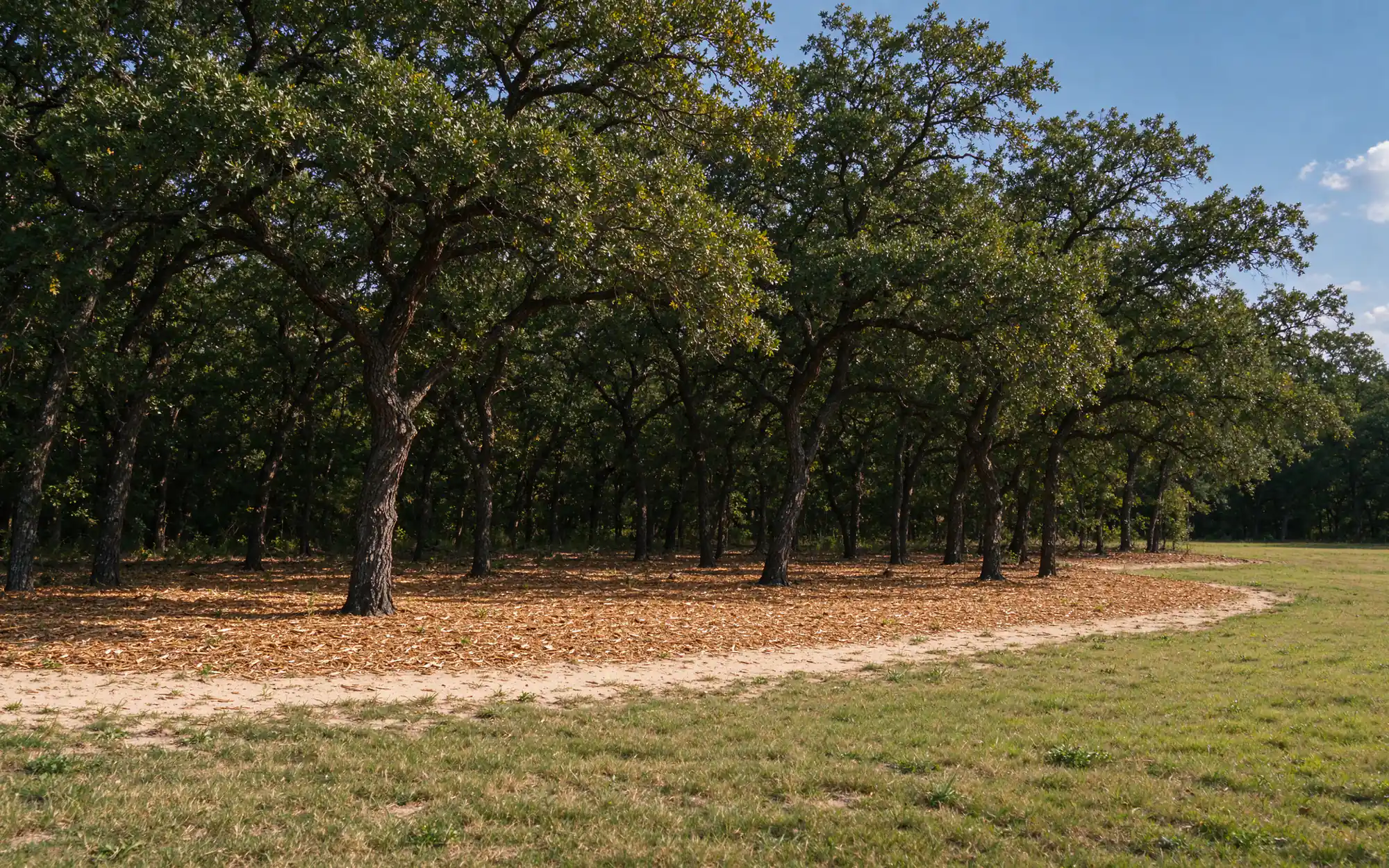
In Aubrey, the permit question is triggered by the vegetation itself. The city’s subdivision ordinance requires a Site Development Permit before any site development work that affects vegetation or tree removal, erosion control, storm drainage or a floodplain, and it applies in the city and its extraterritorial jurisdiction. That reach into the ETJ is what most owners miss. For Homestead Land Clearing, land clearing in Aubrey, TX starts by sorting out whether a job is site development, and if so, getting the pre-construction conference on the calendar before any 6-inch tree comes down.
How Aubrey’s rules shape the work
The permit sequence. Under the subdivision ordinance, every contractor attends a pre-construction conference before the permit is released and before any clearing, filling, excavation or removal of trees larger than 6 inches in caliper. Erosion controls and tree-protection devices must be in place to the City Engineer’s satisfaction first. A published Aubrey tree mitigation table was not found, so no mitigation rate is assumed. For subdivision or commercial land clearing, this conference sits between the plan approval and the first machine.
Burning is possible, with conditions. Aubrey’s outdoor burning article requires a Fire Department permit approved by the fire chief, issued only after the site is inspected and valid only on its day of issue, 8 a.m. to sundown. The burn must sit downwind of and at least 300 feet from structures with sensitive receptors on adjacent properties, or 50 feet with the neighbor’s notarized approval. Wind must be 6 to 20 mph, and the department sets pile size. A county burn ban binds the city. Residential permits are free; a commercial permit is $2,000 for seven days, which often tips a commercial job toward debris removal or mulching. The Collin and Denton burning guide explains how county bans work.
How an Aubrey job usually runs
- Walk the property: boundaries, trees to keep, slopes, wet spots, fences, and what is buried or overhead.
- Check the rules for that address: city or ETJ, whether the work counts as site development, burn options, floodplain limits and Texas811 locates.
- Write the scope: method, finish level, stumps, debris plan and erosion control, in writing, before a price.
- Clear and hand off at the agreed finish, ready for the next trade or for seeding.
Reading Aubrey ground
Aubrey sits on the Cross Timbers side of the county line, and its ground behaves differently from the clay east of Frisco. USDA NRCS soil data around Aubrey, Pilot Point and Cross Roads shows Gasil fine sandy loam, Silstid loamy fine sand and similar well-drained sandy loams, with the Birome-Rayex-Aubrey complex on 2 to 15 percent slopes. Sandy ground carries tracked equipment better after rain than Houston Black clay does, but loose sand on a slope washes fast once the cover is gone. Silt fence and seeding belong in the scope on those tracts, as the erosion control guide explains.
The vegetation follows the soil. Texas Parks and Wildlife describes the East Cross Timbers as post oak and blackjack oak woodland with cedar elm and hickory, plus eastern red cedar, mesquite, bois d’arc and greenbriar. On that kind of tract, selective clearing that removes cedar and understory while keeping the oaks is often the realistic scope, and forestry mulching leaves the ground cover a sandy slope needs.
Growth shows in the permits: Census counted 128 single-family permits in Aubrey in 2024 and 396 the next year. Subdivision tracts that disturb an acre or more fall under TCEQ’s construction stormwater permit, covered in the stormwater permit guide.
Nearby towns with their own rules
Pilot Point
Pilot Point’s online code shows no tree removal permit or mitigation requirement. Its landscape rules protect trees an owner keeps on a construction project, flagged with orange tape and fenced to the drip line where required. Its open burning article was repealed in 2016, and burning now falls under fire code amendments kept on file with the city secretary, so burn conditions are confirmed with the Fire Marshal. Census counted 520 and 573 single-family permits there in 2024 and the year after, more than Aubrey itself. The town sits near Ray Roberts Lake, whose state park TPWD describes as dense post oak, blackjack oak and elm groves.
Cross Roads
Cross Roads protects trees 6 inches and larger, except listed species including mesquite, hackberry, cottonwood, willow and eastern red cedar. Its rule does not apply within 3 acres around a built primary dwelling. Elsewhere on residential or agricultural land outside commercial corridors, owners may remove 7 percent of total protected caliper inches a year and 21 percent in any 5 years, and trees 18 inches or larger need Town Council approval. The 3-acre exemption carries a one-year look-back if the land’s use changes. A large pasture clearing plan there may run over several years.
Providence Village
Providence Village uses the same 7 percent and 21 percent caps, requires a tree removal permit before any protected tree is removed, and exempts mesquite, thorny honey locust, cottonwood, cedar, hackberry and willow. Brush clearing of cedar and mesquite there faces far fewer limits than removing an oak. The town’s rules also keep construction traffic out of protected trees’ critical root zones, with exceptions for clearing underbrush and pad grading, so the access route for a machine is drawn before it arrives.
Aubrey and its neighbors share sandy ground but not rule books. A quote that lists the permit steps saves surprises, and if the land carries an agricultural valuation, read the ag valuation guide before clearing it. Get in touch to start.