
Princeton is one of the few cities around Homestead Land Clearing where the burn question has a flat answer: no. The Princeton Fire Marshal’s office says outdoor burning is not allowed in the city, and it spells out that this includes burning to clear land of trees, stumps and brush. So every land clearing job in Princeton, TX starts with the other question: where does the wood go? Census figures show why that question comes up often. Princeton grew from 16,996 residents in 2020 to an estimated 43,524 in mid-2025, and the Census Building Permits Survey counted 1,948 single-family permits in 2024 and 1,598 the year after.
What changes on a Princeton job
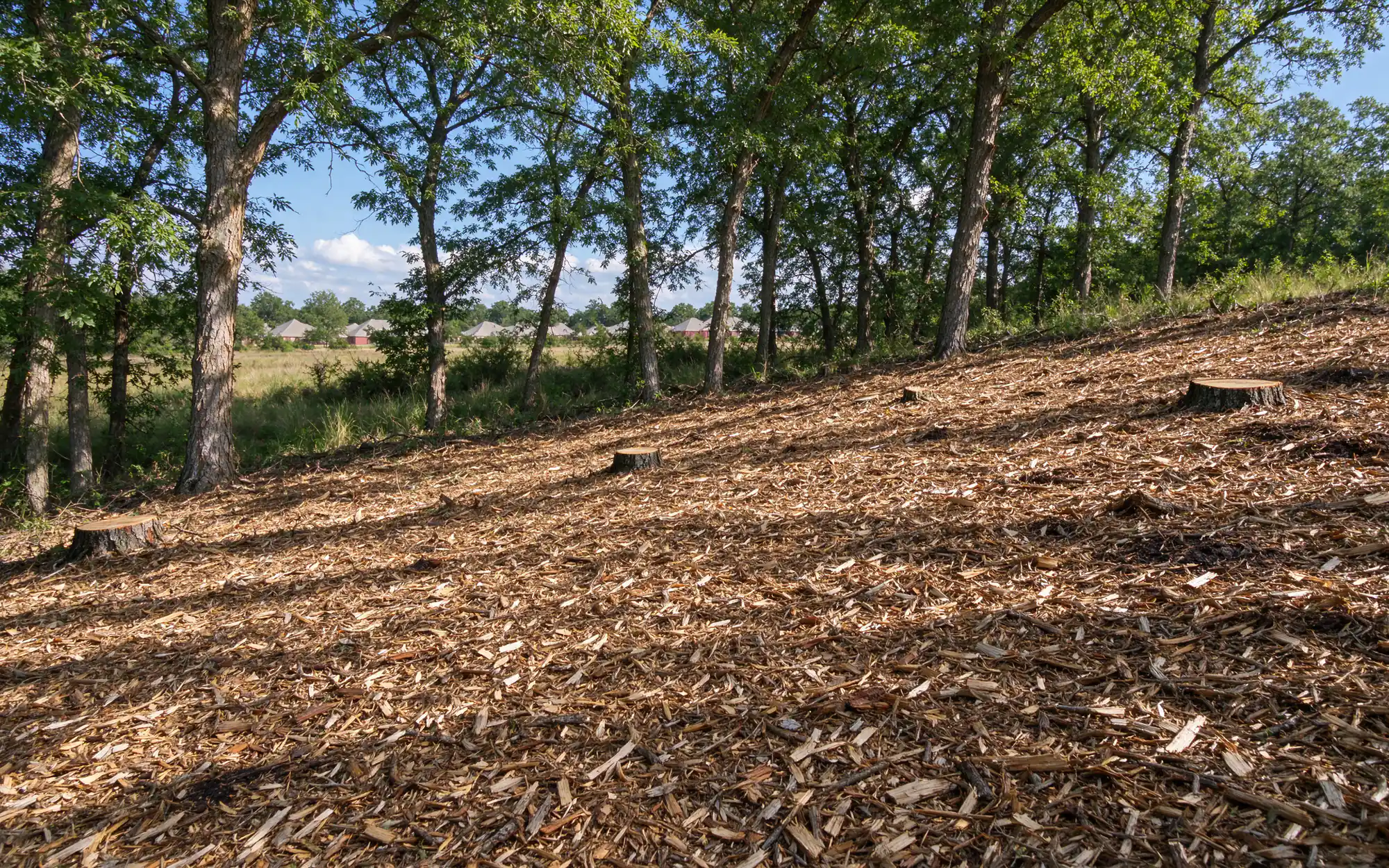
Debris is the first line of the scope, not the last. With no burn path inside city limits, the choice is between leaving the material on site as mulch and removing it. Forestry mulching grinds standing brush and small trees into a layer that stays on the ground, which suits fencerows, back acreage and lots where a thin mulch cover is acceptable. Where the next trade needs bare soil, the material is cut, loaded and taken away under a debris removal plan, and North Texas Municipal Water District publishes the disposal rates: $80 per ton at its transfer stations and $52 per ton at the 121 Regional Disposal Facility, each with a one-ton minimum. The mulching versus clearing guide explains what each finish leaves behind.
The tree rule is checked, not assumed. A standalone Princeton tree removal ordinance could not be located in the city’s published material, which does not prove there is none. Princeton Development Services at 2000 E. Princeton Dr. answers it for the address before any trees are cut.
The city line moves. Princeton’s City Council has adopted a string of resolutions releasing individual tracts from its extraterritorial jurisdiction, so a rural parcel that was once in the ETJ may now fall under county rules alone. Unincorporated Collin County is not covered by the city’s burn ban, but TCEQ still limits land clearing burns across the Dallas-Fort Worth ozone nonattainment area to cases with no practical alternative. The burning guide for Collin and Denton covers how that plays out.
How a Princeton job usually runs
- Walk the property for boundaries, trees worth keeping, slopes, wet spots, fences and anything buried or overhead.
- Check the rules for that address: city or county, the tree question, creek and floodplain limits, and a Texas811 locate before any stump or root work.
- Write the scope in writing before a price: method, finish level, stumps, the mulch-or-haul plan and erosion control.
- Clear and hand off at the agreed finish, ready for the next trade or for seeding.
Reading Princeton ground
USDA NRCS soil data puts most of Princeton on Houston Black clay, the same sticky, shrink-swell soil found across the Collin side. What sets parts of it apart is Ferris-Heiden clay on 5 to 12 percent slopes mapped as severely eroded. That ground has already lost topsoil, and stripping its cover invites rills and gullies after the next storm. On a sloped lot, silt fence along the low side and seeding or a mulch layer over bare soil are written into the scope; the erosion control guide lays out the options.
Most Princeton tracts read as Blackland Prairie farm ground: open fields cut by fencerows and drainage lines grown up in hackberry, bois d’arc, mesquite and cedar. Brush clearing and stump grinding handle the fencerows, while a lot bound for a slab may need clearing and grubbing so roots come out of the footprint. Grubbing and grading are different jobs, and pad work belongs to a separate trade.
Growth adds a paperwork layer. A lot inside a larger subdivision plan counts toward that plan’s total disturbed area under TCEQ’s construction stormwater permit, which starts at one acre; the stormwater permit guide explains who files. NOAA’s 1991 to 2020 normals at DFW Airport show May and October as the wettest months, which on Princeton clay are the likeliest weeks to lose to mud.
Lowry Crossing
Lowry Crossing sits southwest of Princeton and has a tree rule that reaches land before it is developed. Its Tree Preservation article (Ordinance 193) bars cutting, removing or damaging any tree on regulated property without a tree removal permit, and regulated property includes land being subdivided or replatted, reaching into the city’s ETJ where the article says so. The application needs a tree survey listing each tree’s location, caliper and species, and the City Council, not staff, decides each permit and may require mitigation planting. Each tree removed without one is a separate offense, with a fine of up to $500. Lots with an existing occupied one- or two-family home appear among the article’s carve-outs, and that wording is confirmed against the address.
The low ground matters too. USDA NRCS maps frequently flooded Tinn clay on the creek bottoms around Lowry Crossing, toward the East Fork of the Trinity River. Frequently flooded ground is the last to dry after rain and the most likely to carry floodplain limits, so the creek and floodplain guide is worth reading before a subdivision tract is scoped. Census data shows Lowry Crossing issued 199 single-family permits in 2024 and 245 the next year, so this is not a quiet corner.
Services for Princeton and Lowry Crossing
- Lot clearing for a single home site with the debris plan settled first.
- Overgrown lot clearing for vacant parcels that have gone to brush.
- Forestry mulching and debris removal, chosen by the finish the next trade needs.
A Princeton quote that never mentions where the brush goes is missing its most important line. Get in touch with the address and the scope gets built around the mulch-or-haul decision.