
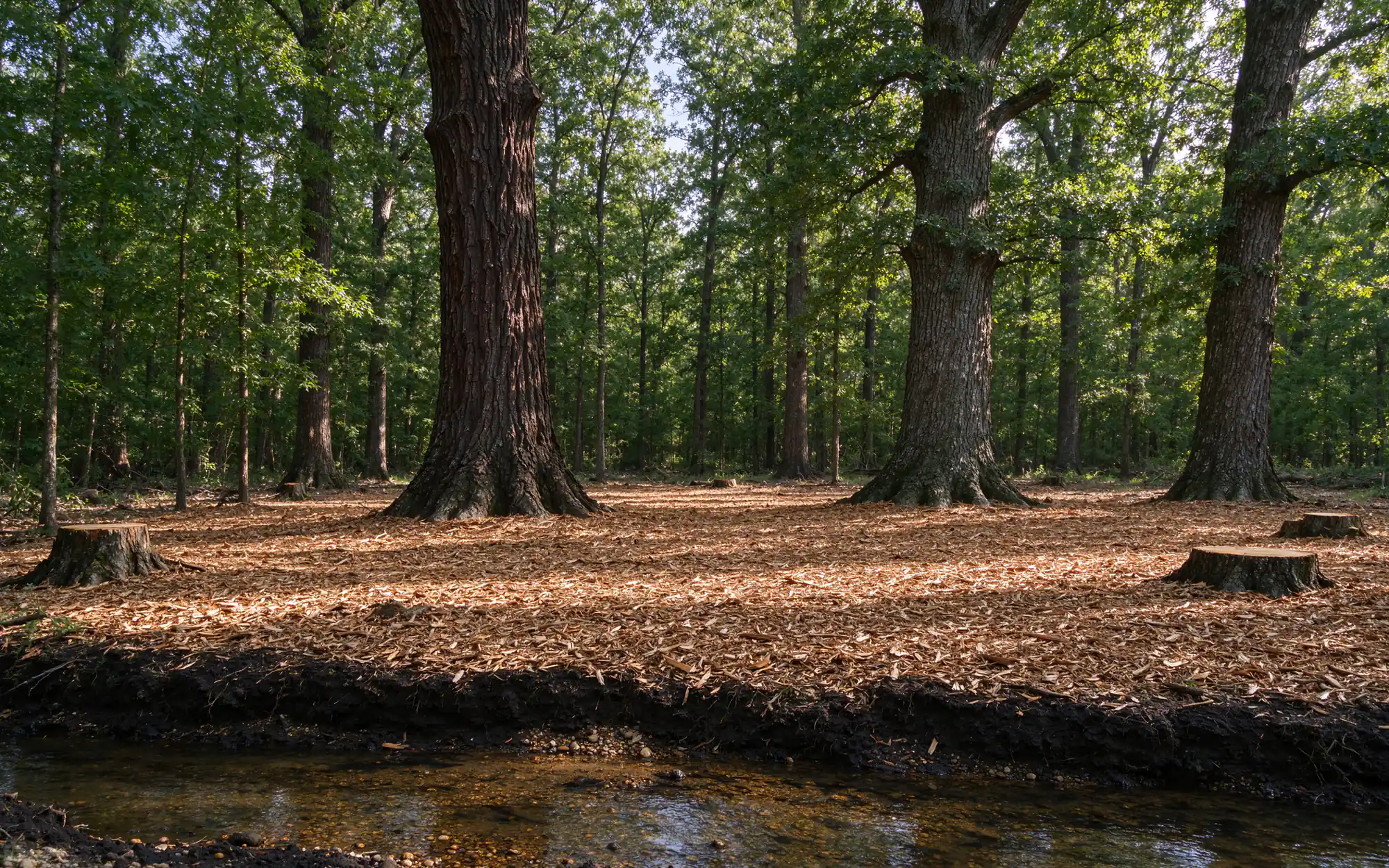
Land clearing in McKinney is governed less by what a machine can do than by what kind of permit the work falls under. McKinney’s tree ordinance, Ordinance 2023-09-064, applies to all property in the city, and it names clearing underbrush with mechanical equipment as work that needs a Limited Purpose Tree Permit. That one line changes how a mulching or brush job is set up. Homestead Land Clearing scopes McKinney work from the permit path backward: which trees on the land are on the Quality Tree list, whether the ground is floodplain or qualified agricultural land, and whether the parcel is in city limits at all. Collin County’s seat grew from 195,331 residents in 2020 to 236,001 by mid-2025 (U.S. Census), with 2,388 and 1,649 new single-family permits in 2024 and 2025.
What makes McKinney different
The permit matrix. McKinney’s Article 4 sorts work into permit types. A Tree Permit covers critical alteration of trees outside a development project. A development project uses a Tree Preservation Plan, and developments of 35 acres or more may instead submit an Aerial Tree Exhibit with a Reforestation Fund payment. The Limited Purpose Tree Permit covers selective thinning, grubbing under drip lines and clearing underbrush with mechanical equipment. Exceptions include a non-specimen tree on an existing single-family lot, underbrush removed with hand tools, dead trees documented by an arborist, and utility work. Selective thinning or drip-line grubbing done under a management plan prepared by a qualifying arborist is exempt. For forestry mulching and brush clearing, that makes the permit step part of the scope, not a formality.
The Quality Tree list. McKinney protects Quality Trees from 6 inches in diameter on non-residential and multifamily properties, development projects, other properties, floodplain and qualified agricultural land, meaning land under a Collin Central Appraisal District agricultural, timber or wildlife appraisal. The list reaches species many North Texas codes leave out: juniper species and mesquite sit beside oaks, pecan, hickory, walnut, sycamore, cypress, most elms (American and Siberian excepted) and most maples (box elder and silver maple excepted). On an existing single-family, duplex, triplex or quadplex use the bar rises to 27 inches for a Quality Tree and 42 inches for a Specimen Tree, and a Specimen Tree cannot be critically altered without the Director of Planning’s approval. A 15-foot perimeter tree zone, up to 30 feet, applies along boundaries with existing platted residential lots.
Replacement. On single-family uses, trees of 27 inches and up are replaced one for one at a 4-inch caliper minimum. On non-residential and multifamily uses, trees of 6 to 16 inches are replaced inch for inch, and larger trees at one inch removed to two replaced. Replacement goes on the same property where possible, otherwise on approved land or as a Reforestation Fund payment on the City’s annual schedule, which this page does not quote. Tree Permit replacements are due within 90 days.
Burning. McKinney issues open burning permits only to the landowner. Its 2024 fire code adoption sets the open burning location at least 300 feet from any structure, and trench burns use an air curtain incinerator. Older McKinney burn forms cited a larger setback, so the current terms are confirmed with the Fire Marshal’s office before any pile is planned. The burning guide covers TCEQ’s nonattainment-area limits that apply on top.
How a McKinney job usually runs
- Walk the property. Boundaries, trees to keep, slopes, wet spots, fences, and anything buried or overhead, with Quality Tree species and anything near 42 inches noted.
- Check the rules for that address. City limits, ETJ or released ETJ; which tree permit applies; burn options; floodplain limits; and a Texas811 locate request.
- Write the scope. Method, finish level, stumps, debris plan and erosion control, in writing before a price.
- Clear and hand off. The site is left at the agreed finish for the next trade or for seeding. Grading and drainage work belong to a separate trade.
Reading McKinney ground
The east side of McKinney drains to the East Fork of the Trinity River, and the creek bottoms feeding it are where the city’s tree rules and its soils press hardest on a clearing job. USDA NRCS soil data maps Tinn clay, rated frequently flooded, along those bottoms, with Houston Black clay on the flats and eroded Altoga silty clay on 5 to 8% slopes above them. Tinn clay holds water long after a rain, and NOAA normals at DFW Airport put the wettest months in May (4.78 inches) and October (4.37 inches). A creek-bottom tract is also floodplain under the ordinance, so the 30% cap on critical alteration applies. Put together, the realistic job there is usually selective clearing or understory mulching that leaves most of the canopy, scheduled for firm ground; the creek and floodplain guide and wet clay guide go deeper.
Rural parcels around the city edge raise a different question. Land on an agricultural appraisal inside McKinney is protected at the 6-inch Quality Tree threshold even though it looks like farm ground, so a cedar and mesquite fencerow on appraised land can need a permit and replacement that the same fencerow in another town would not. Changing the use of that land can also trigger a three-year rollback tax under Texas Tax Code 23.55; the ag valuation guide explains it, and your appraisal district or tax advisor confirms specifics.
City limits themselves are moving. Texas SB 2038, effective September 1, 2023, lets landowners petition to leave a city’s extraterritorial jurisdiction, and McKinney’s 2025 development report on its open-data map lists 22 ETJ releases and 15 annexations. A released parcel falls under county rules, and the Collin County Fire Marshal states that no county office issues burn permits; only TCEQ decides whether a burn qualifies. So the address check comes before the method choice. Oncor lists McKinney among its Collin County communities, but the line owner near any particular parcel is confirmed per address.
Why plan it this way
McKinney’s ordinance is built so that unpermitted clearing is easy to count after the fact: every 1,200 square feet of canopy missing on an aerial image can be its own violation. Pulling the right permit before the mulcher arrives costs a step; skipping it can cost far more. For development sites, clearing that disturbs an acre or more also falls under TCEQ’s construction stormwater permit, covered in the stormwater permit guide. And because the difference between clearing and grubbing maps directly onto McKinney’s permit types, the scope says which one is happening where.
Services for McKinney properties
- Forestry mulching and brush clearing under a Limited Purpose Tree Permit.
- Clearing and grubbing and commercial land clearing for development projects with a Tree Preservation Plan.
- Pasture clearing on rural parcels, with the agricultural-land threshold checked first.
- Land clearing debris removal where burning does not fit the setback.
The mulching versus land clearing guide helps decide which method suits a McKinney tract.
The first questions for any McKinney tract are short: city limits or not, floodplain or not, appraised as agricultural or not. Reach out here with what you know, and the rest gets checked before a price is written.