
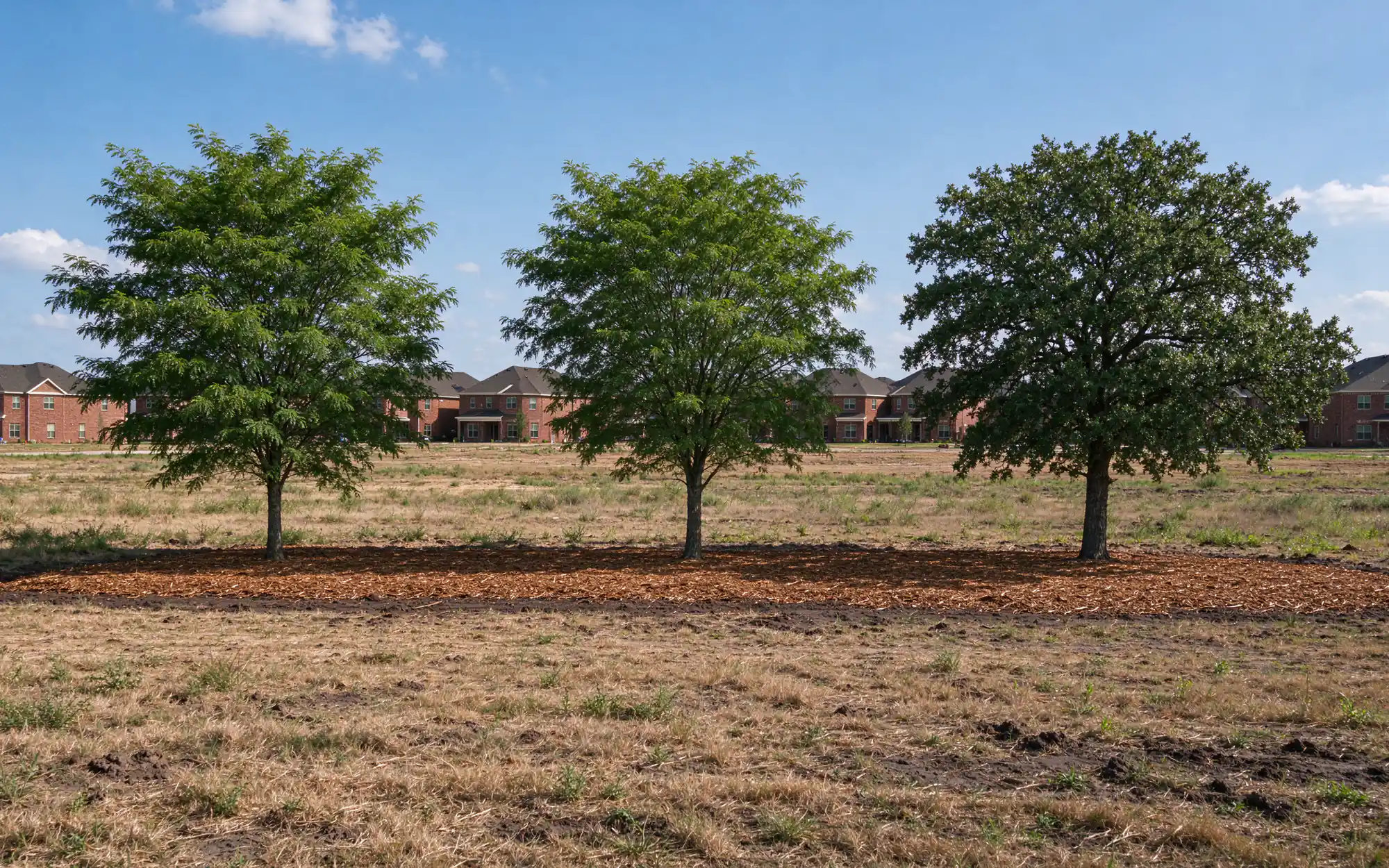
Land clearing in Prosper starts with a species question that most of its neighbors answer differently. Under the Town’s Unified Development Code, a hackberry, bois d’arc or mesquite standing outside the 100-year floodplain is not a protected tree at any size, so a grown-up fencerow of those species can often be cleared without replacement. Move the same tree into the floodplain and it is protected at 6 inches. Homestead Land Clearing plans Prosper work from that line outward, alongside the burn approval and the question of whether the parcel is in town limits at all. Prosper sits directly north of Frisco across US 380, and Census estimates show it grew from 30,171 residents in 2020 to 45,605 by mid-2025, a 51.2% rise.
The rules that shape a Prosper clearing job
What counts as protected. Prosper’s code (Ordinance 2026-24, amended by Ordinance 2026-36) requires a tree permit to remove or transplant trees regardless of size or species, with an exception for a tree on a single-family lot in a plat of record that has a Certificate of Occupancy. Protection applies at 6 inches in diameter outside the floodplain, minus an excluded list: silver maple, hackberry or Texas sugarberry, honey locust, bois d’arc, mimosa, mulberry, white poplar, cottonwood, mesquite and willow. Inside the 100-year floodplain the exclusion falls away and every species at 6 inches is protected. That split is why selective clearing on a Prosper tract usually begins with a floodplain map, not a chainsaw.
What replacement costs in inches. Outside the floodplain the Town requires 100% replacement for trees of 6 to 12 inches, 150% for over 12 to 24 inches and 300% for over 24 to 40 inches. Inside the floodplain the same bands run 150%, 200% and 300%. A tree 40 inches or larger is classed as historic: removing one needs Town Council approval and 500% replacement. Preservation credits of one to five per tree can offset some of the requirement where good trees are kept. Frisco’s scale tops out at 300% for trees over 20 inches, so a very large pecan on the Prosper side of US 380 sits under a different decision than one a mile south.
What the code allows without a machine. Brush under the drip line of a protected tree may be cleared by hand or with turf-tire mowers. Agricultural users can remove protected trees with the Town’s written permission, with replacement prorated over 10 years. Prosper also defines clear-cutting in its code, so a plan to scrape a wooded tract wholesale gets read against that definition first.
Burning is a separate approval. The UDC says burning removed trees, stumps or foliage requires written Fire Department approval. The Fire Marshal’s outdoor burn application has listed a $150 refundable deposit per burn, a 15-day permit life, no burning in wind over 15 mph, a window from one hour after sunrise to one hour before sunset, and a responsible party on site. That form is older and marked subject to change, so its terms are confirmed with the Fire Marshal’s office before a burn is planned. Collin and Denton counties are both in the Dallas-Fort Worth ozone nonattainment area, where TCEQ limits land clearing burns to cases with no practical alternative; the brush burning guide explains how that works alongside county burn bans.
How a Prosper job usually runs
- Walk the property. Boundaries, the trees worth keeping, slopes, wet ground, fences, and anything buried or overhead. In Prosper the walk also marks which trees are on the excluded list and which sit near a creek.
- Check the rules for that address. Town limits or ETJ, Collin or Denton County, the tree permit and survey, written burn approval, floodplain limits and a Texas811 locate request.
- Write the scope. Method, finish level, stumps, debris plan and erosion control, written down before a price.
- Clear and hand off. The site is left at the agreed finish for the next trade or for seeding. Grading and pad work are a separate trade.
Reading a Prosper tract
The excluded-species list matters most on the kind of ground Prosper still has left. Texas Parks and Wildlife describes Collin County as Blackland Prairie that has mostly been farmed or ranched, and on that landscape the trees that volunteer along fencerows and field edges are largely hackberry, bois d’arc and mesquite. Under Prosper’s code those are the species with the least regulatory weight outside the floodplain. A long, overgrown fencerow can therefore be a straightforward fence line clearing job, with the survey used to flag the few pecans, oaks or cedar elms mixed in. Mesquite is the exception in a different sense: Texas A&M AgriLife Extension notes it resprouts from a belowground bud bank, so cutting it at the surface is rarely the end of it, and the brush regrowth guide covers what follow-up looks like.
The floodplain flips that logic. Along Prosper’s creek corridors, a cottonwood or willow that would be unprotected on high ground becomes a protected tree at replacement rates starting at 150%. Removing vegetation in a floodplain can also bring its own permit questions, which the creek and floodplain guide walks through. On these tracts forestry mulching of underbrush with the canopy left standing is often the version of the job that fits the rules.
Then there is the line between town and county. Prosper straddles Collin and Denton counties, and its code states that zoning provisions do not apply in the ETJ. Since September 1, 2023, Texas law has also let landowners petition to release land from a city’s ETJ, so the status of a parcel is checked rather than assumed. Unincorporated Collin County issues no burn permits at all, while unincorporated Denton County runs open burning registration with a daily burn-day decision. USDA NRCS soil data around Prosper shows Houston Black clay, eroded Austin silty clay and Branyon clay, all of which turn soft after rain; NOAA normals at DFW Airport put the wettest months in May and October, so wet clay timing belongs in the schedule. Electric service is split too: the Town lists Oncor, CoServ and Grayson-Collin Electric Cooperative, so the line owner near a given parcel is confirmed per address.
Why plan it this way
In Prosper, the expensive mistakes are about classification, not machinery. A crew that treats a floodplain hackberry like an upland one can turn a no-replacement tree into a 150% obligation, and one that misses a 40-inch tree has skipped a Town Council step entirely. Texas Local Government Code 212.905 also limits mitigation fees on smaller trees at an owner’s own existing home and requires cities that charge fees to offer planting credits, which can matter on an established lot. If the land carries an agricultural valuation, a change of use can trigger a three-year rollback tax; the ag valuation guide explains the mechanics, and a tax advisor confirms the specifics. For the history of the code itself, see what changed in Prosper’s tree ordinance.
Services for Prosper properties
- Selective clearing where protected trees must be tagged and kept.
- Brush clearing and pasture clearing for fencerows and grown-up fields.
- Lot clearing for custom home sites once the permit order is set.
- Land clearing debris removal when burning is not approved or not wanted.
The cost per acre guide sets out the published budgeting ranges and what moves a job toward the top of them.
Before anything is cut in Prosper, three facts settle most of the job: town limits or ETJ, floodplain or upland, and which trees are on the excluded list. Contact us with those, or with the questions they raise, and the scope gets written around the answers.